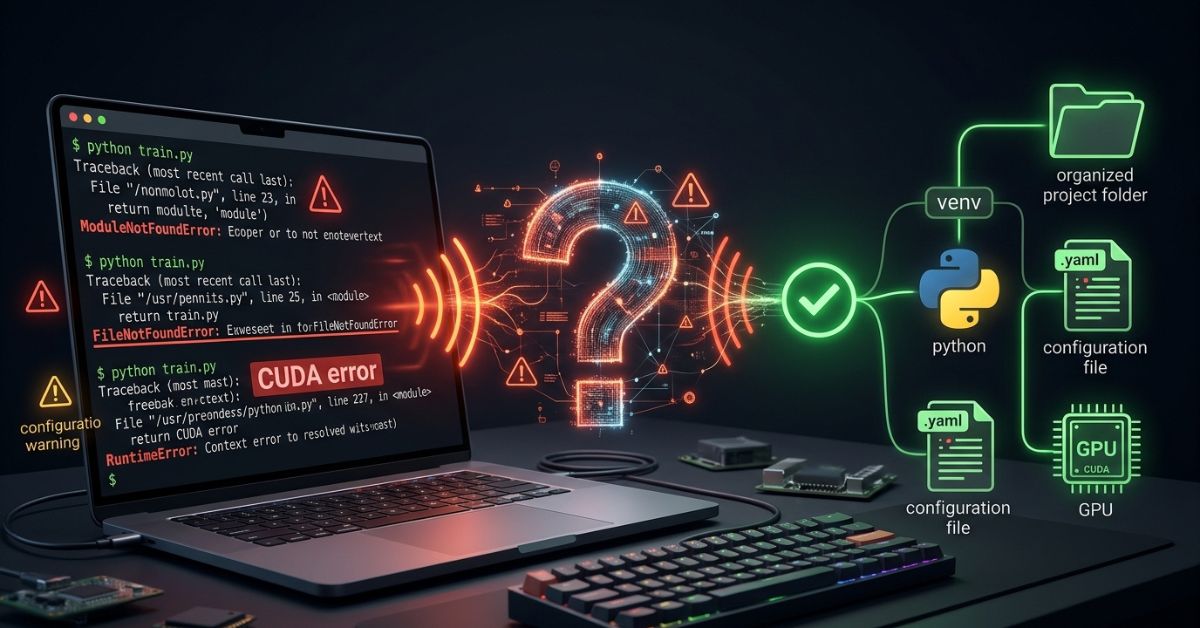
GenBoosterMark code usually stops working because your Python setup is off, needed tools are missing, setup files have mistakes, secret keys are missing, file paths are wrong, or your graphics card setup has issues.
Start with a quick check to find where your program stops before you change any code.
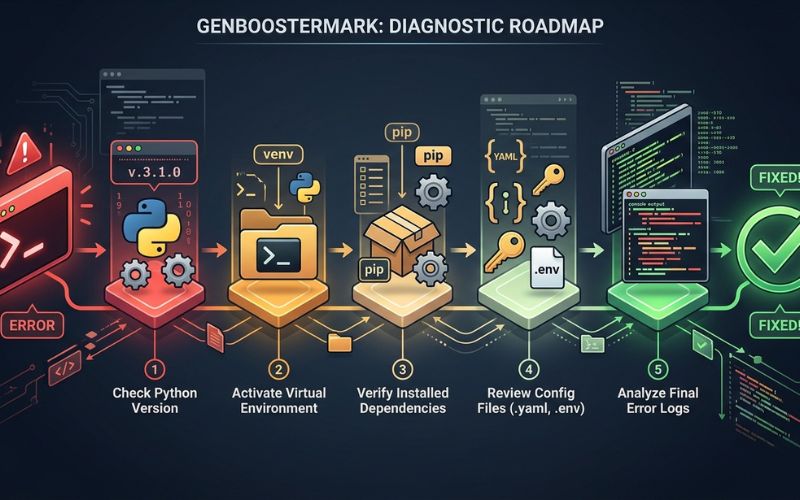
[ Error Happens ]
       │
       ▼
[ 1. Check Python & Virtual Box ]
       │
       ▼
[ 2. Check Extra Tools ]
       │
       ▼
[ 3. Check Setup Files & Folders ]
       │
       ▼
[ 4. Check Graphics Card / Internet Connection ]
       │
       ▼
[ Try Running Code Again ]
Start Here: 5-Minute Quick Check
When your code stops working, do not worry or rewrite your work. Follow these short steps to find the exact problem:
- Check your Python version: Type
python --versionorpython3 --versionin your terminal to see which Python you have. - Check your active folder: Look for a bracket name like
(venv)at the start of your terminal line. - Check your tools: Type
pip install -r requirements.txtto install any missing tools. - Check files and settings: Make sure your
.envfile, setup files, and model folders are in place. - Find the error message: Read the very last line of the error text on your screen to see what went wrong.
Why Can’t I Run My GenBoosterMark Code?
To run GenBoosterMark, your computer, files, and code tools must work together. One wrong setting can stop the program from starting.
Here are the main reasons your code fails to start:
- Wrong Python version: Using a Python version that does not work with your project.
- Missing tools: Forgetting to download the needed software packages.
- Turned-off folder setup: Installing tools on your main computer instead of inside your project folder.
- Wrong setup files: Typing errors or bad spacing in your YAML or JSON settings files.
- Missing secret keys: Forgetting to put key codes inside your
.envfile. - Wrong file locations: Typing file paths that do not point to real folders.
- Locked folders: Your computer blocking you from opening or saving files in a folder.
- Graphics card driver problems: Using screen drivers that do not match your smart code tools.
- Internet connection problems: Sending bad keys or wrong settings to online services.
- Cloud service differences: Running home code on websites like Google Colab or Docker without changing the settings.
Fix Python Version and Folder Setup Problems
Python programs need the right version and a clean workspace to run well on different computers.
Check Which Python and Pip Are Working
Your computer might have a few Python versions installed. You need to check which one is answering your commands.
On Windows PowerShell:
PowerShell
Get-Command python
Get-Command pip
On macOS or Linux:
Bash
which python3
which pip3
If these commands show main system folders instead of your project folder, your project workspace is turned off.
Helpful Tip: Look at project files like
pyproject.toml,requirements.txt, or project notes to see which Python version your GenBoosterMark code needs.
Create a Clean Project Workspace
A virtual workspace is a private folder for your project’s tools. It stops your project from mixing up tools with other programs on your computer.
On Windows:
DOS
python -m venv venv
On macOS or Linux:
Bash
python3 -m venv venv
Turn On the Workspace and Test It
You must turn on your workspace before downloading tools or running your code.
On Windows PowerShell:
PowerShell
.\venv\Scripts\Activate.ps1
On macOS or Linux:
Bash
source venv/bin/activate
After turning it on, run which python3 or Get-Command python again. The path on screen should now point inside your project’s venv folder.
Pick a Workspace Helper
You can manage Python project folders using three common tools:
| Tool | Best Used For | Good Things | Drawbacks |
| venv | Regular Python projects | Comes built into Python and is light | Cannot download new Python versions |
| Conda | Science work and graphics tasks | Downloads extra code libraries easily | Takes up a lot of storage space |
| pyenv | Changing Python versions | Swaps main Python versions fast | Harder to set up on Windows |
Fix Missing or Clashing Tools
Missing tools stop your code from starting right away. Clashing tool versions can cause your code to crash while it is running.
Install Your Project Tools
Download all needed software using the project’s tool list file:
Bash
pip install -r requirements.txt
If your project uses a pyproject.toml file, install it in edit mode:
Bash
pip install -e .
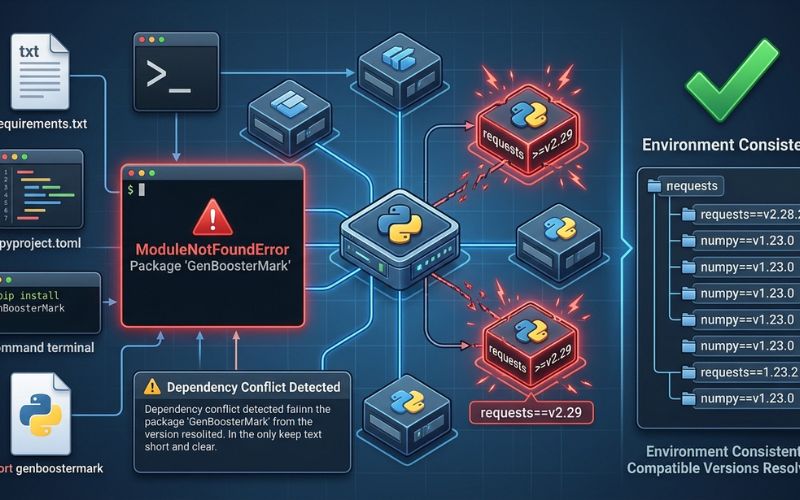
Fix “ModuleNotFoundError”
A ModuleNotFoundError happens when Python cannot find a tool listed in an import line in your code.
Plaintext
ModuleNotFoundError: No module named 'yaml'
The word used in code does not always match the exact download name on the web. For example, to use yaml in code, you must download PyYAML:
Bash
pip install PyYAML
Find Tool Version Conflicts
If a tool is installed but your code still crashes, run this command to find clashing packages:
Bash
pip check
If tools clash, you will see an error showing which packages need different versions:
Plaintext
genboostermark 1.0.0 has requirement requests>=2.31.0, but you have requests 2.25.1.
Check the details of any tool using pip show <package-name> before updating it so you do not break other working tools.
Fix GenBoosterMark Setup File Errors
GenBoosterMark uses setup files to choose program choices and model settings.
Check YAML Spacing
YAML files use spaces to group items. If you use the Tab key instead of spaces, your program will crash when it starts.
YAML
# Good YAML spacing
model:
  name: "genboostermark-v1"
  batch_size: 16

# Bad YAML spacing (Will cause a text error)
model:
   name: "genboostermark-v1"
 batch_size: 16
Check JSON Formatting
If your setup file uses JSON format, make sure it follows these simple rules:
- Put double quotes around every name (
"key"). - Remove extra commas at the end of lists or groups.
- Make sure every opening bracket has a closing bracket.
Check Setting Names and Value Types
Setup files must use the exact names and value types your code expects. Passing text like "16" when your code needs a plain number like 16 can cause errors.
Use a Simple Setup File to Find the Issue
Test your program using a very small setup file. This helps you figure out if your main code is broken or if your big setup file just has typing errors.
YAML
# Simple test setup (Example only)
project_name: "test_run"
device: "cpu"
debug_mode: true
Fix Secret Keys and .env File Problems
Programs use secret settings to hold passwords, file locations, and internet keys safely.
Check if Needed Keys Are Active
Check if your system secret keys are loaded in your open terminal window.
On Windows PowerShell:
PowerShell
Echo $env:API_KEY
On macOS or Linux:
Bash
echo $API_KEY
Check .env File Location and Loading
Put your .env file in the main project folder where you type your commands. Helper tools look in your open folder by default.
Note that helper tools only load keys if your code calls the load command. If you move your .env file into a subfolder, you must type the exact path to that file in your code.
Check Name Spelling and Formatting
Follow these rules when writing your .env file:
- Do not put spaces around the equals sign (
KEY=value, notKEY = value). - Do not use quotation marks unless spaces are part of your secret key.
- Match capital and small letters exactly.
Keep Your Keys Safe
Hide your secret keys when sharing error messages or pictures on the internet.
Code snippet
# Safe hidden example
GENBOOSTER_API_KEY="gb_live_xxxxxxxxxxxxxxxxxxxx"
DATABASE_URL="postgresql://user:REDACTED@localhost:5432/mydb"
Fix File, Folder, Model, and Path Errors
Folder errors happen when Python cannot find your input data, saved models, or output folders.
Check Short Paths vs. Full Paths
Short paths change depending on where you open your terminal window. Use path commands in Python to build solid file locations:
Python
from pathlib import Path

# Find the exact full path based on this code file location
BASE_DIR = Path(__file__).resolve().parent
DATA_FILE = BASE_DIR / "data" / "input.json"
Check Your Open Terminal Folder
Check where your terminal is looking before running your code.
On Windows:
DOS
cd
On macOS or Linux:
Bash
pwd
Make sure your open folder matches the file locations used in your code.
Check Model Files
Smart model files are very big and must be downloaded separately. Make sure your model files are fully downloaded and unzipped in the right folder.
Check Capital Letters in File Names
Capital letters matter depending on your operating system. Linux strictly checks capital letters, while Windows and macOS usually ignore them. A path like Models/Weights.bin will fail on Linux if the real folder is named models/weights.bin.
Plaintext
FileNotFoundError: [Errno 2] No such file or directory: 'models/weights.bin'
If you see this error, check your open folder path with pwd or cd and check the exact spelling of your file name.
Fix Folder Lock and Access Errors
Computer safety rules can stop GenBoosterMark from reading input files or saving output files.
Check Your Target Folder
Make sure your computer user account is allowed to open, read, and save files in your project folders.
Fix Windows Access Blocked Issues
If Windows blocks access to a folder, change folder access rights:
- Right-click your project folder and pick Properties.
- Click the Security tab.
- Click your user account name and make sure Full control or Write is checked.
Fix macOS and Linux Permission Issues
On Linux or macOS, give write access to output folders:
Bash
chmod 755 ./output_folder
If another user account owns the files on Linux, change file ownership to your account:
Bash
sudo chown -R $USER:$USER ./project_folder
On macOS, use chown -R $USER ./project_folder without extra group text if ownership warnings show up.
Warning: Do not run Python code using system admin commands like
sudo. Running as admin can lock your project workspace and create safety risks.
Fix Graphics Card (GPU), CUDA, and Tool Errors
When GenBoosterMark uses a graphics card to run faster, mismatched driver software can stop your code from running.
Check if Your Graphics Card Is Found
Check if your computer sees your graphics card. Run the NVIDIA test tool in your terminal:
Bash
nvidia-smi
If this command shows your graphics card name and driver number, your hardware is working. If you see “command not found,” download and install your graphics card drivers.
Check NVIDIA Drivers and CUDA Tools
Smart coding tools rely on graphics drivers. You can check if full CUDA helper tools are installed on your computer:
Bash
nvcc --version
If nvcc is not found, the full CUDA setup is missing from your system path. However, tools like PyTorch often bring their own CUDA code and can still use your graphics card if your main driver is up to date.
Check Tool Support for Graphics Cards
Installing PyTorch with a basic command might give you a CPU-only version. Run this short check in Python to test graphics card access:
Python
import torch
print(torch.cuda.is_available())
If it says False, PyTorch cannot use your graphics card. Reinstall PyTorch using the official guide on the PyTorch website to match your computer drivers.
Test CPU Mode to Find the Problem
Turn off graphics card access for a moment to test if your code runs on your main computer processor (CPU).
On Linux or macOS:
Bash
export CUDA_VISIBLE_DEVICES=""
On Windows PowerShell:
PowerShell
$env:CUDA_VISIBLE_DEVICES=""
If your code runs in CPU mode, your main application code works fine. This means the problem comes from your graphics card drivers or CUDA setup.
Fix Internet Keys, Settings, and Sign-In Errors
If your code crashes while sending data over the internet, check your network settings and request formats.
Check API Keys and Accounts
Make sure your internet key is active, pasted correctly into your .env file, and has enough account credits to run.
Check Required Settings and Sent Data Format
Online services reject requests that leave out needed settings or send bad data types. For example, sending text where a number is needed will cause an error response.
JSON
// Example Internet Error Response
{
  "error": {
    "code": "invalid_parameter",
    "message": "batch_size must be an integer, got string '16'"
  }
}
Understand Internet Error Numbers
Web requests return simple status numbers that tell you why a request failed:
| Error Number | What It Means | What to Check |
| HTTP 400 | Bad Request | Check setting names and data types |
| HTTP 401 | Not Signed In | Check your key for typos or extra spaces |
| HTTP 403 | Access Denied | Check account limits or rights |
| HTTP 404 | Page Not Found | Check the web address and API version |
| HTTP 500 | Server Error | The website is down; check their status page |
Quick Command List for Windows, macOS, and Linux
Different computer systems use different terminal commands. Use this table to find the right command for your computer:
| Task | Windows PowerShell | macOS / Linux Terminal |
| Check Python version | python --version | python3 --version |
| Make virtual workspace | python -m venv venv | python3 -m venv venv |
| Turn on workspace | .\venv\Scripts\Activate.ps1 | source venv/bin/activate |
| Check program location | Get-Command python | which python3 |
| Download tools | pip install -r requirements.txt | pip install -r requirements.txt |
| Check folder locks | Security tab in File Explorer | ls -la and chmod 755 |
Running GenBoosterMark on Google Colab
Google Colab gives you free cloud graphics cards on the web, but these web computers wipe clean when your session ends.
- Pick a GPU workspace: Click Runtime > Change runtime type and select a GPU hardware accelerator.
- Download tools every time: Put download commands at the top of your notebook:Bash
!pip install -r requirements.txt - Connect Google Drive to save files:Python
from google.colab import drive drive.mount('/content/drive') - Use Colab Secrets for keys: Store secret keys in the Secrets tab (key icon) instead of typing keys into code cells.
- Restart workspace after downloading: Click Runtime > Restart session if you update installed tools.
Running GenBoosterMark with Docker
Docker runs programs inside neat, isolated boxes so code works the same way on every computer.
Plaintext
[ Main Computer ] ──► [ Docker Box ──► Python Setup ──► GenBoosterMark ]
- Link project folders: Use folder flags (
-v $(pwd):/app) so your Docker box can read home files and save output logs. - Pass secret key files: Load keys using the
--env-file .envflag when starting your container. - Turn on graphics support: Use the
--gpus allflag so your Docker box can use your computer’s graphics card.
What Common GenBoosterMark Error Messages Mean
Use this table to match error text to simple fixes:
| Error Text | Likely Cause | What to Check First | Simple Fix |
ModuleNotFoundError | Missing code tool | Active project folder | Type pip install <package> |
ImportError | Clashing tool versions | Tool list in pip list | Match required tool versions |
FileNotFoundError | Wrong file path | Open folder (pwd) | Use full file paths |
PermissionError | Locked folder | Folder access rights | Turn off folder read-only lock |
yaml.parser.ParserError | Bad YAML spacing | Tab key usage or alignment | Use spacebar spaces only |
KeyError | Missing secret key | Key names in .env | Add missing key to .env file |
CUDA error | Driver or tool mismatch | nvidia-smi output | Match CUDA and PyTorch versions |
HTTP 400 / 401 | Internet setting error | Request data format | Fix key and parameter values |
A Safe Diagnostic Script for Your Computer
Save and run this helper code inside your project folder to test your computer setup safely. It checks your system without changing files or revealing secret keys.
Python
import os
import sys
from pathlib import Path

def run_diagnostics():
    print("=== GenBoosterMark System Test ===")
    print(f"Python Version: {sys.version.split()[0]}")
    print(f"Program Location: {sys.executable}")
    print(f"Current Folder: {Path.cwd()}")

    # Check common example tools
    example_packages = ["yaml", "requests", "torch"]
    print("\n--- Checking Example Tools ---")
    for pkg in example_packages:
        try:
            __import__(pkg)
            print(f"  [OK] {pkg} is installed.")
        except ImportError:
            print(f"  [MISSING] {pkg} is NOT installed.")

    # Check key project files
    print("\n--- Checking Project Files ---")
    for file_name in ["requirements.txt", ".env", "config.yaml"]:
        path = Path.cwd() / file_name
        status = "Found" if path.exists() else "Missing"
        print(f"  {file_name}: {status}")

    # Check graphics card access
    print("\n--- Checking Graphics Card Support ---")
    try:
        import torch
        gpu_available = torch.cuda.is_available()
        print(f"  CUDA Available: {gpu_available}")
        if gpu_available:
            print(f"  GPU Name: {torch.cuda.get_device_name(0)}")
    except ImportError:
        print("  PyTorch not installed; skipping GPU check.")

    print("\n=== Test Complete ===")

if __name__ == "__main__":
    run_diagnostics()
Good Test Result Example
Plaintext
=== GenBoosterMark System Test ===
Python Version: 3.11.4
Program Location: /home/user/project/venv/bin/python
Current Folder: /home/user/project

--- Checking Example Tools ---
  [OK] yaml is installed.
  [OK] requests is installed.
  [OK] torch is installed.

--- Checking Project Files ---
  requirements.txt: Found
  .env: Found
  config.yaml: Found

--- Checking Graphics Card Support ---
  CUDA Available: True
  GPU Name: NVIDIA GeForce RTX 3080

=== Test Complete ===
How to Find the Real Problem From Error Logs
A Python error log shows a list of steps that led to a crash. Follow these steps to find out what went wrong:
- Read the very last line first: The bottom line shows the exact error type and short explanation.
- Look for your project files: Look up the list of lines to find files that belong to your project folder.
- Check the line number: Open that file in your code editor to find the exact command that failed.
- Find the main cause: Separate the main crash from smaller warnings caused by the first failure.
Simple Problem-Solving Flowchart
Follow this simple flow to narrow down where your program fails:
Plaintext
Does the program start?
 ├── NO ──► Check Python version, workspace activation, and downloaded tools.
 └── YES ─► Do setup files load cleanly?
             ├── NO ──► Check YAML/JSON spacing and .env keys.
             └── YES ─► Does CPU mode work?
                         ├── NO ──► Check file paths and internet keys.
                         └── YES ─► Check NVIDIA drivers and CUDA settings.
Common Mistakes to Avoid
- Downloading Python tools to your main computer instead of using a project workspace folder.
- Copying example setup files without changing file paths to match your computer.
- Misspelling key names inside your
.envfile. - Changing many software tools at once instead of testing one change at a time.
- Running commands from inside subfolders instead of your main project folder.
Prevention Checklist
Use this checklist to keep your project setup clean for future runs:
- [ ] Write down the supported Python version in your project notes.
- [ ] Use a private project workspace folder (
venv). - [ ] Install software tools using a saved
requirements.txtfile. - [ ] Save secret keys in a
.envfile listed inside.gitignore. - [ ] Use code path builders to locate files safely.
- [ ] Test code in CPU mode before using graphics card power.
When the Problem Is Not Your Code
Sometimes issues outside your code stop your program from running:
- Internet service outages: Online servers or sign-in systems are temporarily down.
- Model download blocks: Model websites like Hugging Face are unreachable due to internet limits.
- Bad tool updates: A newly updated software tool brought a bug. Lock your tool numbers in
requirements.txtto keep things working.
Check official project status pages and help guides before rewriting your code.
Frequently Asked Questions
Why can’t I run my GenBoosterMark code?
Code stops running because your project workspace is turned off, tools are missing, setup files have typing errors, or file paths point to missing folders.
How do I check which Python version GenBoosterMark is using?
Type python --version or python3 --version in your terminal. You can also print sys.executable inside a Python code file to see the active program path.
How do I fix a GenBoosterMark “ModuleNotFoundError”?
Turn on your project workspace and type pip install <package-name>. Check that the name in your code matches the official tool name on the web.
Why does GenBoosterMark work on one computer but not another?
Different capital letters in file paths, missing .env keys, or different graphics drivers usually cause code to fail on new computers.
How do I fix a GenBoosterMark YAML configuration error?
Open your .yaml file and fix spacing errors. Use spaces instead of tab keys for indenting text, and keep lines neatly aligned.
Why can’t GenBoosterMark find my model file?
Check that your model files are downloaded and saved in the folder listed in your setup file. Use full file paths to avoid path errors.
How do I fix a GenBoosterMark CUDA error?
Make sure your NVIDIA graphics drivers are updated. Check that your PyTorch setup supports your graphics card using torch.cuda.is_available().
Can I run GenBoosterMark in Google Colab?
Yes. Pick a GPU setup under Runtime > Change runtime type, download tools using !pip install, and store keys in Colab Secrets.
How do I fix GenBoosterMark permission errors?
Make sure your user account has write access to your project folders. On Linux or macOS, update folder rights using chmod 755 <folder_name>. Do not use sudo to run code.
What should I include when asking for help with an error?
Share your operating system name, Python version, full terminal error text, redacted .yaml setup files, and your downloaded tool list from pip list.
Handpicked For You:
Telekom FintechAsianet Explained: Meaning, Real Status, Services & Phone-Money Links
When Was the Game InnerLiftHunt Released? Simple Fact Check Guide
Disclaimer:
This article is provided for informational and educational purposes only. It is not professional, technical, legal, or security advice. Software, commands, and settings may change by version or system. Some images may be AI-generated for illustrative purposes. All copyrights and trademarks belong to their respective owners.