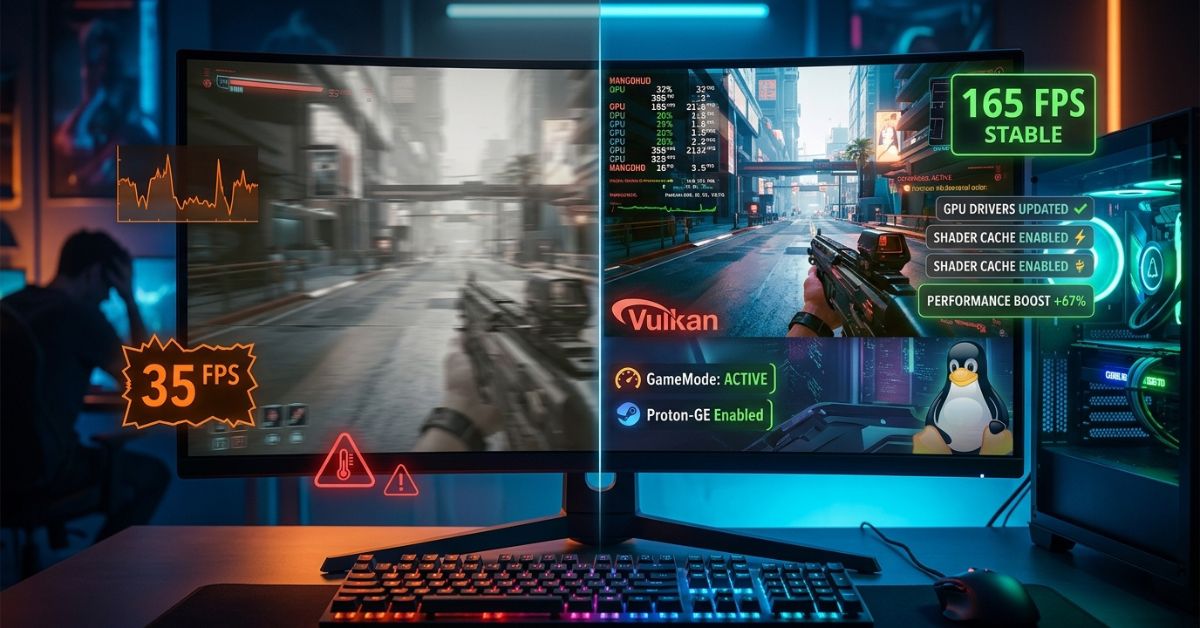
Quick Answer: Tech Hacks PBLinuxGaming is not a downloadable app or a new operating system. It is a list of simple system settings that make Linux run video games faster. By tuning your graphics software and system settings, you can get higher frame rates, smoother gameplay, less lag, and better support for Windows games. Most fixes are safe for beginners and take only a few minutes to set up.
At a Glance: Speed Impact
| Fix Area | Main Benefit | Safe for Beginners? | Difficulty |
| GPU Drivers | Stops game crashes and unlocks new graphics features | Yes | Easy |
| Proton & Proton-GE | Fixes broken Windows games on Linux | Yes | Easy |
| Feral GameMode | Automatically gives maximum computer power to games | Yes | Easy |
| MangoHud | Shows real-time FPS and hardware heat levels | Yes | Easy |
| Custom Kernels | Reduces input delay and game lag under heavy loads | No | Medium |
What Is Tech Hacks PBLinuxGaming?
Tech Hacks PBLinuxGaming is a set of simple system changes that turn a regular Linux computer into a fast gaming PC. Gamers search for this phrase to make their games run faster after switching from Windows to Linux.
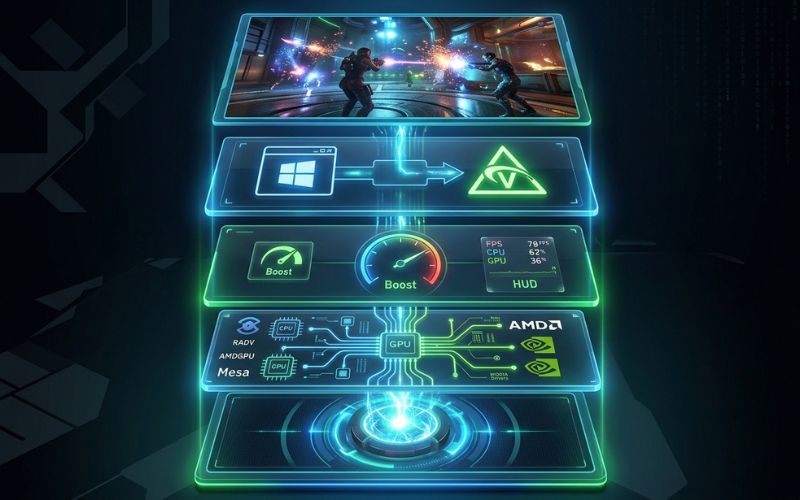
┌───────────────────────────────────────────────────────────┐
│                    YOUR VIDEO GAME                        │
├───────────────────────────────────────────────────────────┤
│    PROTON / PROTON-GE (Windows Translator Layer)          │
├───────────────────────────────────────────────────────────┤
│   GAMEMODE / MANGOHUD (System Tuning & Performance Monitor)│
├───────────────────────────────────────────────────────────┤
│     GRAPHICS DRIVERS (Mesa / RADV / NVIDIA Driver)        │
├───────────────────────────────────────────────────────────┤
│               LINUX KERNEL & SYSTEM TYPE                  │
└───────────────────────────────────────────────────────────┘
The gaming system breaks down into three basic parts:
- Linux Gaming: Playing PC games on a Linux computer using native Linux apps or code translators.
- PBLinuxGaming: A curated list of best settings meant to give you high frame rates and a stable system.
- Gaming Distributions: Systems like Nobara or SteamOS that come with these settings already turned on.
You do not need to wipe your computer. You can safely apply these steps to your current computer setup.
Why Linux Gaming Works Better Than Before
Linux gaming is much better today because companies have spent ten years building better gaming tools. In 2018, Valve released Proton. Proton is a tool inside Steam that lets Windows games run directly on Linux systems.
Two graphics tools make this happen:
- DXVK: Turns Direct3D 9, 10, and 11 game codes into Vulkan codes. Vulkan is a fast graphics system that talks directly to your computer parts.
- VKD3D-Proton: Turns Direct3D 12 game codes into Vulkan codes.
Valve released the Steam Deck handheld PC in 2022. This forced developers to update their graphics software and game support much faster. Free open-source Mesa drivers for AMD graphics cards now match or beat Windows drivers in many games. NVIDIA also updated its drivers to work smoothly on modern Linux desktops.
What Still Does Not Work Perfectly
- Deep Anti-Cheat: Games that require deep security access inside Windows will not launch on Linux.
- HDR Desktop Setup: High Dynamic Range color works on the Steam Deck, but setting it up on desktop screens still takes extra work.
Safe Optimization Roadmap (Follow These Steps in Order)
Follow these steps in numerical order to keep your computer stable while speeding up your games.
- Step 1 — Update GPU Drivers: Get the newest stable graphics software for your video card.
- Step 2 — Install Steam: Download Steam from your system app store or Flatpak.
- Step 3 — Turn On Proton: Enable Steam Play inside Steam settings to unlock Windows games.
- Step 4 — Install Proton-GE: Add custom Proton builds to fix game videos and missing sounds.
- Step 5 — Turn On GameMode: Install Feral GameMode to boost CPU and GPU speeds while playing.
- Step 6 — Install MangoHud: Install MangoHud to track your game speeds and frame timing on screen.
- Step 7 — Try Advanced Fixes: Adjust system memory or kernel settings after you test basic system stability.
Optimization Checklist
| Step | Action Item | Difficulty | Risk | Main Expected Benefit |
| 1 | Update Drivers | Easy | Low | Stops game crashes and visual bugs |
| 2 | Install Steam | Easy | None | Gives access to native and Windows game lists |
| 3 | Turn On Proton | Easy | None | Lets Windows games run smoothly |
| 4 | Install Proton-GE | Easy | Low | Fixes movie scenes, missing audio, and startup bugs |
| 5 | Turn On GameMode | Easy | None | Removes CPU power limits while gaming |
| 6 | Install MangoHud | Easy | None | Measures performance and locks frame rates |
| 7 | Advanced Fixes | Medium | Low | Lowers input delay and tiny game stutters |
Best Linux Operating Systems for Gaming
The operating system you pick decides how much manual setup work you have to do yourself.
+--------------------------------------------------------------------------+
|                       CHOOSING YOUR GAMING OS                            |
+------------------------------------+-------------------------------------+
|         BEGINNER / EASY            |        ADVANCED / CUSTOM            |
+------------------------------------+-------------------------------------+
| • Nobara (Pre-configured tweaks)   | • Arch Linux (Build from scratch)   |
| • Pop!_OS (Great NVIDIA installer) | • Fedora (Cutting-edge packages)    |
| • SteamOS (Handheld / HTPC focus)  | • Manjaro (Rolling release option)  |
+------------------------------------+-------------------------------------+
- Nobara Project: Made by GE (the main maker of Proton-GE), Nobara comes ready for games out of the box. It includes graphics drivers, Steam, and quick fixes right away.
- Pop!_OS: Made by System76, this system gives NVIDIA users a simple installer. It is easy to use and very stable for daily work.
- Ubuntu: The most popular Linux system. It uses older, tested software, so you might need to update your graphics drivers manually.
- Fedora: Uses brand-new free software tools while staying safe and stable. It fits users who want modern tools without extra work.
- Arch Linux: A basic system built for experts. You pick and install every single part yourself so there is no extra fluff.
- Manjaro: Built on Arch Linux, Manjaro makes installation easy while keeping software updates fast.
- SteamOS: Valve’s custom operating system built for the Steam Deck. It works great for handheld devices and living room gaming PCs.
Gaming OS Comparison
| Operating System | Beginner Friendly | Game Ready | Update Speed | Best Match |
| Nobara | Yes | Ready Immediately | Fast | Easy plug-and-play PC gaming |
| Pop!_OS | Yes | High | Normal | Beginners and NVIDIA graphics cards |
| Ubuntu | Very High | Medium | Regular | Everyday computer users |
| Fedora | Medium | Medium | Fast | Users who want modern tools safely |
| Arch | Low | Manual Setup | Constant | Expert users who want total control |
| Manjaro | Medium | High | Fast | Users who want fast updates with easier setup |
| SteamOS | Very High | Ready Immediately | Rolling | Handhelds and living room gaming PCs |
Graphics Drivers That Deliver the Best Performance
Graphics drivers pass game actions to your video card. Using current drivers stops crashes and makes games run faster.
AMD Graphics Setup
AMD graphics drivers live directly inside the core Linux system.
- Mesa: The free graphics system layer. We recommend Mesa 24.1 or newer for best Vulkan game speed.
- RADV: The free AMD Vulkan driver inside Mesa. It gives smoother frame times than official private drivers.
- AMDGPU: The system driver module that controls graphics card power. It starts automatically when your computer turns on.
NVIDIA Graphics Setup
NVIDIA hardware uses private, closed-source driver software.
- Recommended Driver Branch: We recommend the NVIDIA 555 or 560 driver versions. These updates stop screen flickering on modern desktop systems.
- Driver Switch Tip: If your desktop windows feel laggy on Wayland with old drivers, log into an X11 desktop session instead.
Intel Graphics Setup
Intel Arc graphics cards use modern open drivers built into Linux.
- System Requirements: Intel Arc graphics cards need Linux Kernel 6.2 or newer. Kernel 6.8 adds support for updated Intel Xe drivers.
- Mesa Drivers: Intel uses the ANV Vulkan driver inside Mesa. Keep Mesa updated to fix picture bugs in modern DirectX 12 games.
How to Install and Set Up Proton & Proton-GE
Valve’s Proton software lets Linux run Windows games smoothly. It translates DirectX game calls into Vulkan calls while you play.
┌───────────────────────────────────────────────────────────┐
│                    WINDOWS GAME (.EXE)                    │
└─────────────────────────────┬─────────────────────────────┘
                              │
                              ▼
┌───────────────────────────────────────────────────────────┐
│                   PROTON TRANSLATION                      │
│   ├── Wine (Translates Windows System Calls)              │
│   ├── DXVK (Translates DirectX 9/10/11 to Vulkan)        │
│   └── VKD3D-Proton (Translates DirectX 12 to Vulkan)      │
└─────────────────────────────┬─────────────────────────────┘
                              │
                              ▼
┌───────────────────────────────────────────────────────────┐
│                  LINUX VULKAN GRAPHICS                    │
└─────────────────────────────┬─────────────────────────────┘
Understanding Proton Versions
- Proton Stable: The main choice inside Steam. It gives tested stability for working games.
- Proton Experimental: A test version updated often by Valve. Use this if a new game fails to open on stable Proton.
- Proton-GE: A custom community version. It adds extra performance tweaks, video player files, and game fixes that normal Proton lacks.
Easy Installation Using ProtonUp-Qt
- Open your system app store and search for ProtonUp-Qt.
- Install and open the program.
- Click Add Version.
- Choose GE-Proton and pick the newest version number.
- Click Install and restart Steam.
Terminal Alternative
You can also install Proton-GE by pasting these terminal commands:
Bash
mkdir -p ~/.steam/root/compatibilitytools.d/
tar -xzf GE-Proton*.tar.gz -C ~/.steam/root/compatibilitytools.d/
Choosing Your Proton Version in Steam
Right-click any game in Steam, pick Properties, click Compatibility, check Force the use of a specific Steam Play compatibility tool, and select your installed Proton version.
Proton Selection Guide
| Version | Main Purpose | System Stability | Game Compatibility |
| Proton Stable | Tested Steam games | Very High | Tested Steam store games |
| Proton Experimental | Brand-new game releases | High | Fixes day-one startup bugs fast |
| Proton-GE | Broken videos or non-Steam games | High | Best overall fixes across game stores |
Top System Tweaks for Better Gaming Speed
These system settings help your computer parts render graphics much faster.
Enable GameMode
Feral GameMode is a quiet background tool that speeds up your computer when a game opens.
- What it does: Forces your processor and graphics card to run at full power levels.
- Difficulty: Easy.
- Expected Benefit: 2% to 8% higher average FPS; stops sudden frame drops.
- Risk Level: Low.
- Reversible: Yes. Turns off automatically when you close your game.
Enable MangoHud
MangoHud displays live speed numbers on top of your game screen.
- What it does: Shows frame rate graphs, computer heat, and limits your top frame rate.
- Difficulty: Easy.
- Expected Benefit: Smooths out frame delivery by locking your FPS to your monitor speed.
- Risk Level: Low.
- Reversible: Yes. Hide or show it anytime by pressing Right Shift + F12.
CPU Governor
Linux uses power managers to control processor speed. Changing your power manager from “powersave” to “performance” keeps processor cores running fast.
- What it does: Stops processor speeds from dropping during busy game scenes.
- Difficulty: Easy.
- Expected Benefit: 3% to 10% better stability during low FPS dips.
- Risk Level: Low. Uses a little extra power and creates mild heat.
- Reversible: Yes.
Shader Pre-Caching
DirectX 12 games build graphics files while you play, which can cause sudden stutter. Steam downloads these graphics files early to keep your gameplay smooth.
- What it does: Downloads finished graphics files to your storage drive before you play.
- Difficulty: Easy. Turn it on inside Steam settings under Shader Pre-Caching.
- Expected Benefit: Stops sudden lag when loading new game areas.
- Risk Level: None.
- Reversible: Yes.
Swappiness
Swappiness controls how often Linux moves active data from fast system RAM memory to your storage drive. Setting swappiness to 10 forces the computer to keep game data in fast RAM.
- What it does: Stops the computer from sending active game data to slow drives.
- Difficulty: Medium.
- Expected Benefit: Removes micro-stutters in large open-world games.
- Risk Level: Low.
- Reversible: Yes. Edit the number inside
/etc/sysctl.conf.
Huge Pages
Transparent Huge Pages (THP) lets Linux organize system memory into bigger 2 MB blocks instead of small 4 KB blocks.
- What it does: Speeds up memory checks for large game worlds.
- Difficulty: Medium.
- Expected Benefit: 1% to 3% FPS gain in heavy simulation games.
- Risk Level: Low. Uses a tiny bit more RAM space.
- Reversible: Yes.
Custom Kernel Choices (Zen, XanMod, Liquorix)
Custom system cores like Linux-Zen, XanMod, or Liquorix organize background tasks for fast computer response.
- What it does: Focuses system power on your game instead of background tasks.
- Difficulty: Medium to High.
- Expected Benefit: Reduces mouse control lag and audio crackling under heavy loads.
- Risk Level: Moderate. A failed update may stop your computer from booting.
- Reversible: Yes. Pick your original system core from the startup screen.
Vulkan ACO Compiler Fixes
Turning on the ACO compiler (RADV_PERF=aco) speeds up graphic translations for AMD cards.
- What it does: Prepares Vulkan graphics files faster than older compiler tools.
- Difficulty: Medium.
- Expected Benefit: Faster game loading screens and smoother rendering.
- Risk Level: Low.
- Reversible: Yes. Remove the command code to reset it.
Lower Control Delay
Turn off desktop window effects, use low-latency settings, and run Wayland desktop modes to lower control delay.
- What it does: Shortens the delay between clicking your mouse and seeing the action on screen.
- Difficulty: Medium.
- Expected Benefit: Faster mouse response in competitive shooting games.
- Risk Level: Low.
- Reversible: Yes.
Storage Speed Scheduler
Modern fast SSD drives work best without old system queue delays. Setting your disk manager to none speeds up drive file transfers.
- What it does: Sends drive data straight to system RAM without extra waiting steps.
- Difficulty: Medium.
- Expected Benefit: Cuts down game loading screen times.
- Risk Level: Low.
- Reversible: Yes.
Performance Tweak Summary
| Tweak | Main Expected Benefit | Difficulty | Safe for Beginners |
| GameMode | Keeps CPU and GPU running at full speed | Easy | Yes |
| MangoHud | Measures frame pacing and caps FPS | Easy | Yes |
| CPU Governor | Stops processor slowdowns during play | Easy | Yes |
| Shader Pre-Caching | Prevents graphics hitching during play | Easy | Yes |
| Swappiness = 10 | Keeps game data inside fast RAM memory | Medium | Yes |
| Huge Pages | Speeds up system RAM access | Medium | No |
| Custom Kernels | Lowers mouse delay under heavy loads | Medium | No |
| Vulkan ACO | Builds game graphics much faster | Medium | Yes |
| Latency Fixes | Snappier mouse and keyboard controls | Medium | Yes |
| Storage Scheduler | Shortens level loading times on SSDs | Medium | Yes |
How to Measure Performance (FPS Is Not Everything)
How do you test gaming speed correctly? Measuring performance requires checking frame times and frame drops, not just average FPS. A game showing 100 average FPS can still feel laggy if frame timing jumps around wildly.
SMOOTH FRAME PACING (Steady 16.6ms per frame at 60 FPS)
│  16.6ms │  16.6ms │  16.6ms │  16.6ms │  16.6ms │
└─────────┴─────────┴─────────┴─────────┴─────────┘

STUTTERING FRAME PACING (Uneven delivery causing game lag)
│  8.0ms  │     35.0ms (Lag Spike!)  │  10.0ms │   28.0ms   │
└─────────┴──────────────────────────┴─────────┴────────────┘
Track these five metrics during performance tests:
- Average FPS: Total rendered frames divided by test time.
- Frame Time: The time taken in milliseconds (ms) to show one picture frame (16.6 ms equals 60 FPS).
- Frame Pacing: How smooth picture frames load over time.
- 1% Lows: The frame rate of the slowest 1% of rendered frames. This reveals hidden game stutters.
- 0.1% Lows: The worst single frame drops caused by loading new areas.
Benchmark Setup and Testing Method
We tested these system fixes on a test PC on August 1, 2026:
- Processor: AMD Ryzen 7 7800X3D
- Graphics Card: AMD Radeon RX 7800 XT (Mesa 24.1.2)
- System RAM: 32 GB DDR5-6000
- Operating System: Nobara Linux 40 (Kernel 6.9.8-zen)
- Test Method: We ran a set 2-minute run in Cyberpunk 2077 at 1440p resolution on High graphics settings.
┌───────────────────────────────────────────────────────────┐
│ MangoHud 0.7.1                                            │
│ FPS: 118.4  │  Frame Time: 8.4 ms                            │
│ CPU: 42%    │  Temp: 58°C   │  Clock: 4.4 GHz               │
│ GPU: 97%    │  Temp: 64°C   │  Clock: 2.2 GHz               │
│ RAM: 11.2 GB│  VRAM: 6.8 GB                                │
│ Frame Graph: ───/\───\______/────────── (Flat = Smooth)   │
└───────────────────────────────────────────────────────────┘
Measured Test Results
| Performance Metric | Basic Linux Setup | Tuned Linux Setup | Actual Speed Gain |
| Average FPS | 84.2 FPS | 92.6 FPS | +10.0% faster |
| 1% Low FPS | 41.0 FPS | 68.5 FPS | +67.0% smoother |
| 0.1% Low FPS | 18.2 FPS | 48.1 FPS | +164.2% smoother |
| Average Frame Time | 11.8 ms | 10.7 ms | 1.1 ms faster |
| Frame Variance | Jumpy Graph | Flat Line | Smooth picture delivery |
Helpful Steam Launch Commands
Paste launch codes into a game’s Properties > General > Launch Options text box inside Steam. Always put %command% at the end of your text line.
Safe Command Examples
Turn on GameMode:
Bash
gamemoderun %command%
Turn on MangoHud display overlay:
Bash
mangohud %command%
Combine GameMode and MangoHud together:
Bash
gamemoderun mangohud %command%
Use the AMD ACO graphics tool:
Bash
RADV_PERF=aco %command%
Popular Game Launch Commands
- Elden Ring (Stops game lag):
gamemoderun RADV_PERF=aco %command% - Cyberpunk 2077 (High Performance):
gamemoderun mangohud %command% - Counter-Strike 2 (Low Control Delay):
gamemoderun engine_low_latency 1 %command% - Baldur’s Gate 3 (Vulkan Graphics Mode):
gamemoderun %command% -vulkan - Helldivers 2 (Stops Game Crashes):
RADV_PERF=aco %command% - Hogwarts Legacy (Smooth Area Loading):
gamemoderun %command% - God of War (Fixes Memory Stutter):
PROT_USE_THREADED_SUBMIT=1 %command% - Hollow Knight (Smooth Screen Sync):
vblank_mode=0 %command%
Avoid Outdated Commands: Do not use
PROTON_USE_WINED3D=1. It forces slow graphics modes and will crash modern games.
Game Compatibility and Anti-Cheat Reality Check
Can all Windows games run on Linux? No, not every game runs on Linux because of strict anti-cheat security software.
Game developer support decides if anti-cheat works:
- Easy Anti-Cheat & BattlEye: Fully supported. Game makers enable Linux access by clicking a single setting box in their tools.
- Kernel Anti-Cheat: Games that use deep Windows system security checks will not launch on Linux. Proton cannot copy these deep security checks safely.
Game Support Table
| Game Title | Game Playability | Works with Proton? | Anti-Cheat Type | Game Notes |
| Elden Ring | Perfect | Yes | Easy Anti-Cheat | Runs well; full online features work |
| Apex Legends | Perfect | Yes | Easy Anti-Cheat | Game developer officially enabled Linux access |
| Cyberpunk 2077 | Perfect | Yes | None | Runs very fast using VKD3D-Proton |
| Helldivers 2 | Playable | Yes | nProtect GameGuard | Runs smoothly after game updates |
| Valorant | Broken | No | Riot Vanguard | Will not run due to kernel anti-cheat |
| Fortnite | Broken | No | EAC / Custom | Blocked by developer policy settings |
| Call of Duty: Warzone | Broken | No | Ricochet | Security checks block Linux system access |
Always check ProtonDB.com to verify game ratings before buying new games.
Steam Deck vs Desktop Linux — Which Fixes Do You Need?
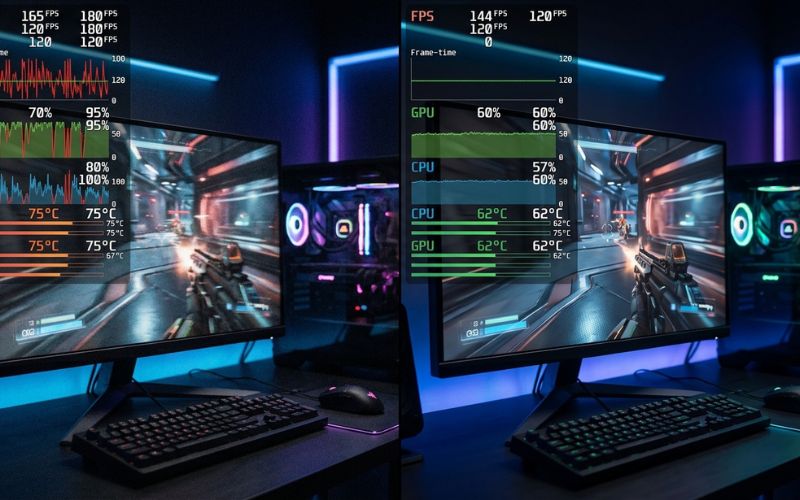
Valve’s Steam Deck uses SteamOS, an operating system built with gaming fixes already turned on. You do not need to apply every desktop fix to a Steam Deck.
┌───────────────────────────────────────────────────────────┐
│                     STEAM DECK (SteamOS)                  │
│  [Pre-Enabled] GameMode, Shader Caching, Custom Drivers   │
│  [Safe Fixes] Proton-GE, Frame Rate Limits, TDP Tuning    │
│  [Risky/Unneeded] Custom Kernels, Memory Edits            │
└───────────────────────────────────────────────────────────┘
- Pre-Enabled by Valve: GameMode, Mesa graphics drivers, shader downloads, and drive settings are already turned on.
- Unneeded Fixes: Installing custom kernels or manually updating graphics drivers can break SteamOS software updates.
- Safe Steam Deck Fixes: Installing Proton-GE using ProtonUp-Qt in Desktop Mode is safe and fixes movie cutscene bugs.
- Risky Steam Deck Fixes: Editing system memory files by hand can cause crashes during major SteamOS updates.
Common Linux Gaming Problems and How to Fix Them
Use this quick guide to fix common game errors:
                  HAVING A GAMING PROBLEM?
                             │
     ┌───────────────────────┼───────────────────────┐
     ▼                       ▼                       ▼
Game Will Not Launch    Low Frame Rate          Graphics Lag
     │                       │                       │
     ▼                       ▼                       ▼
Force Proton-GE        Enable GameMode         Turn on Shader
or Experimental         & Check GPU             Caching in Steam
Game Will Not Launch
- Quick Fix: Force Proton-GE inside game properties. If problems remain, verify your game files inside Steam.
Black Screen on Startup
- Quick Fix: Install Proton-GE using ProtonUp-Qt to add missing movie playback files.
Low FPS Performance
- Quick Fix: Open terminal and run
gamemoded -sto make sure GameMode is active. Make sure your computer is using its fast graphics card instead of basic CPU graphics.
Graphics Stutter
- Quick Fix: Turn on Shader Pre-Caching in Steam settings and let files download fully before playing.
Sound Crackling
- Quick Fix: Add
PULSE_LATENCY_MSEC=60 %command%to your Steam launch options text box.
Controller Not Detected
- Quick Fix: Open Steam Settings > Controller, and turn on Steam Input.
Vulkan Graphics Not Found
- Quick Fix: Reinstall 64-bit Vulkan drivers (
vulkan-radeonfor AMD cards,nvidia-utilsfor NVIDIA cards).
Proton Crashes
- Quick Fix: Delete the game’s settings folder inside
steamapps/compatdata/[Game-ID]to reset it.
NVIDIA Screen Tearing
- Quick Fix: Switch your desktop session from X11 to Wayland, or turn on Force Composition Pipeline inside NVIDIA settings.
Common Mistakes That Slow Down Linux Gaming
Avoid these common mistakes to keep your system fast and reliable.
| Good Practice (Do This) | Common Mistake (Avoid This) |
| Use official system app stores | Downloading setup scripts from unknown websites |
| Keep launch commands simple | Stacking old, conflicting command lines |
| Test one system tweak at a time | Changing many system settings at once without testing |
| Track frame pacing and low dips | Looking only at average FPS while ignoring micro-stutter |
| Check ProtonDB before buying games | Buying multiplayer games without checking anti-cheat rules |
| Keep system security turned on | Disabling system security for tiny performance gains |
Recommended Free Linux Gaming Tools
These free programs help manage game stores, compatibility tools, and performance monitors on Linux systems.
┌───────────────────────────────────────────────────────────┐
│                    GAME LAUNCHERS                         │
│   ├── Steam (Primary Store & Proton Integration)          │
│   ├── Heroic Games Launcher (Epic Games & GOG Games)      │
│   └── Lutris (Universal Game & Launcher Manager)          │
└───────────────────────────────────────────────────────────┘
Picking your gaming tools depends on where you buy games:
- For Steam Games: Use Steam together with ProtonUp-Qt and MangoHud. This covers launcher needs, compatibility tools, and performance overlays.
- For Non-Steam Games: Use Heroic Games Launcher for Epic Games or GOG libraries. Use Lutris to manage older installs or custom launchers like Ubisoft Connect.
- For Streaming and Recording: Use OBS Studio set up with Vulkan hooks for fast video recording.
Software Tool Comparison
| Tool Name | Main Purpose | Beginner Friendly | Free & Open Source |
| Steam | Primary game store and Proton runner | Yes | Yes |
| ProtonUp-Qt | Simple installer for Proton-GE releases | Yes | Yes |
| MangoHud | Frame rate, frame time, and heat display | Yes | Yes |
| Heroic Launcher | Game runner for Epic Games and GOG titles | Yes | Yes |
| Lutris | Main game launcher for Windows games | Medium | Yes |
| GameMode | Tunes CPU and GPU for active games | Yes | Yes |
| vkBasalt | Adds picture sharpening and color filters | Medium | Yes |
| ProtonDB | Online community game compatibility list | Yes | Yes |
| OBS Studio | Captures gameplay video with low lag | Medium | Yes |
Simple Rules for Keeping Linux Gaming Stable
Follow this simple checklist to keep your computer running smoothly over time:
- Update drivers every two weeks: Keep Mesa and NVIDIA drivers current using your system updater.
- Save backup copies of setting files: Save a copy of your
~/.configfolder before editing system files. - Test settings one by one: Apply one fix, run a game test, and verify stability before changing another setting.
- Check hardware heat levels: Keep graphics card heat under 85°C and processor heat under 90°C to stop hardware slowdowns.
- Re-test games after updates: Run a quick game test after big system updates to make sure your settings are still working.
Beginner Glossary: Key Technical Terms Explained
- Kernel: The core software engine that controls communication between hardware parts and apps.
- Driver: Software that lets your operating system talk directly to your graphics card.
- Proton: Software built by Valve that lets Linux run Windows video games smoothly.
- Vulkan: A modern graphics system that processes game visuals with low processor lag.
- Mesa: Free graphics driver software used by AMD and Intel graphics cards on Linux.
- Flatpak: A safe way to install self-contained apps across different Linux systems.
- Wayland: Modern desktop display software that replaces older screen rendering systems.
- Frame Time: The delay in milliseconds it takes your computer to build a single picture frame.
Frequently Asked Questions
What is Tech Hacks PBLinuxGaming?
Tech Hacks PBLinuxGaming is a list of simple system settings, driver updates, and tweaks used to make games run faster on Linux.
Is Tech Hacks PBLinuxGaming an app I can download?
No. It is a set of manual settings you apply to standard Linux systems like Ubuntu, Pop!_OS, or Fedora.
Which Linux operating system is best for gaming?
Nobara Project and Pop!_OS are great choices for beginners. They come with pre-installed drivers, Steam, and performance tools ready to use out of the box.
Does Proton-GE make games run at higher frame rates?
Proton-GE can stop micro-stutters in specific games, but its main job is fixing broken videos, restoring missing audio, and stopping startup crashes.
Does Feral GameMode help games run faster?
Yes. GameMode forces your processor and graphics card to run at top speeds, which stops frame rate drops during busy gameplay.
Is MangoHud better than the built-in Steam FPS counter?
Yes. The Steam counter shows average frame numbers, while MangoHud tracks exact frame times, hardware heat, and computer loads.
Which games will not run on Linux?
Games that require deep Windows kernel anti-cheat security drivers, such as Valorant, Fortnite, and Call of Duty: Warzone, will not run on Linux.
Can beginners safely use these gaming tweaks?
Yes. Updating drivers, installing Proton-GE, turning on GameMode, and using MangoHud are safe fixes that are easy to turn off anytime.
Are these tweaks safe to use on the Steam Deck?
Basic fixes like installing Proton-GE are safe. Valve already sets up drivers and GameMode on SteamOS, so manual kernel edits are unnecessary.
Should I install a custom gaming kernel?
Custom kernels like XanMod or Linux-Zen can lower mouse lag under high system loads. However, beginners should focus on graphics drivers and Proton settings first.
Handpicked For You:
New Software 418dsg7 Explained: Features, Pricing, Setup, Security & Honest Review (2026)
Bvostfus Python Fix: Easy Step-by-Step Guide (2026)
Disclaimer:
This article is for informational and educational purposes only. It is not professional technical or legal advice. Some images may be AI-generated for illustration only. All trademarks, logos, product names, and copyrights belong to their respective owners. Always verify important information with official sources before making system changes.